 Basebridge
 Ethereum-Base Transfers After Portal Retirement
Basebridge was the now-retired Base Bridge portal for ETH transfers between Ethereum and the Base network. Its former entry point now directs visitors to Base’s bridge-route information. The standard bridge contracts still support ETH and compatible ERC-20 transfers between those chains, while current access depends on the selected interface and asset.
last updated
The retired frontend, the Ethereum-Base contracts, and today’s ecosystem services have different roles. Deposits move assets toward Base; canonical withdrawals move them back to Ethereum. Other supported entry paths follow their own networks and implementations.
The Retired Portal and Its Replacement Entry Points
The original portal no longer provides the active bridging interface; Ethereum-Base alternatives include Superbridge and the alternative L1-Base bridge listed alongside it in Base’s documentation. These routes cover ETH and supported ERC-20 transfers between Ethereum mainnet and Base. Retirement applies to the former website, while the standard bridge retains a separate contract interface. Asset availability belongs to the chosen route: support for an ERC-20 transfer depends on the actual token pair and the interface’s supported assets.
Ethereum and Base in the Standard Bridge
Within the standard bridge, Ethereum is layer 1 (L1), and Base is layer 2 (L2). ETH is the native asset handled by the ETH transfer methods. ERC-20 is the interface used for compatible fungible tokens. These asset families have distinct bridge calls, so an ETH transfer and an ERC-20 transfer do not supply identical inputs.
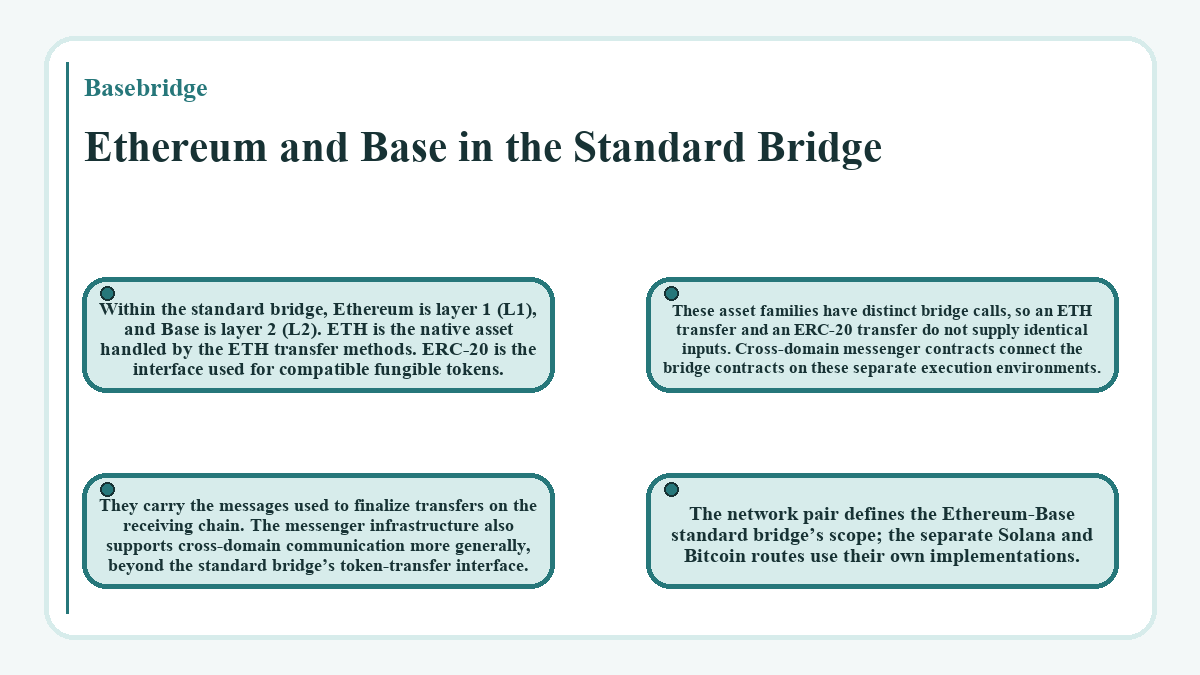
Cross-domain messenger contracts connect the bridge contracts on these separate execution environments. They carry the messages used to finalize transfers on the receiving chain. The messenger infrastructure also supports cross-domain communication more generally, beyond the standard bridge’s token-transfer interface. The network pair defines the Ethereum-Base standard bridge’s scope; the separate Solana and Bitcoin routes use their own implementations.
ETH Calls and ERC-20 Token Pairs
Asset type determines the contract method and the information needed to describe a transfer. ETH uses a payable call, while ERC-20 methods identify a token pair and an amount.
ETH Transfer Methods
ETH transfers use
bridgeETH
or
bridgeETHTo
in the contract interface. A payable call carries ETH value with the transaction. The
To
form specifies a receiving address, allowing the destination recipient to differ from the sender. In the Bedrock implementation, the recipient must accept ETH and cannot be the destination bridge or messenger. Failed delivery leaves ETH locked until a replay succeeds; a recipient that always reverts can lock it permanently. These are contract capabilities; a particular frontend may expose fewer recipient controls.
ERC-20 Counterparts
Local and remote token addresses identify the ERC-20 pair, relative to the chain where the call runs. The standard bridge supports tokens native to either L1 or L2. For compatible pairs, it escrows the native token and mints a representation on the other chain. Return transfers burn that representation and release escrowed tokens. A matching ticker alone cannot establish the required counterpart.
Standard Bridge Call Parameters
ERC-20 calls specify the address pair, token quantity, relay gas requirement, and additional transfer data explicitly. Each input belongs to a particular contract call. Its Solidity type describes how the value is encoded; its role describes what the bridge uses it for.
| Parameter | Value Type | Role in the Transfer |
|---|---|---|
_localToken
|
address
|
ERC-20 contract on the calling chain |
_remoteToken
|
address
|
Corresponding ERC-20 contract on the other chain |
_amount
|
uint256
|
ERC-20 quantity in raw token units |
_minGasLimit
|
uint32
|
Minimum gas the bridge message can be relayed with |
_extraData
|
bytes
|
Additional data carried with the transfer and emitted in events |
The minimum gas limit concerns execution resources on the destination side. It is not a fee quoted in ETH or a transfer duration. Ethereum-to-Base protocol deposits pay for their Base execution gas on Ethereum. Network fee conditions therefore affect the deposit cost. The API types do not supply a universal bridge price or completion time.
Initiation and Finalization Records
A successful initiation transaction records the transfer’s start on its originating chain. The standard interface defines
ETHBridgeInitiated
and
ERC20BridgeInitiated
events for this stage.
Destination-side bridge completion has
ETHBridgeFinalized
and
ERC20BridgeFinalized
events. Their distinction from initiation explains why a successful source-chain transaction can precede completion on the other chain. A frontend’s transaction status needs its chain and transfer stage to be understood correctly.
The event fields identify the sender, recipient, amount, and extra data. ERC-20 records also include the local and remote token contracts. The asset and transfer direction determine how to interpret each amount.
Ethereum deposit events provide data from which Base nodes derive an L2 deposit transaction. Inclusion and execution are distinct: a deposit transaction can be included with a receipt indicating execution failure.
The Bedrock standard bridge accepts finalization only through its messenger, which must identify the other bridge as the cross-domain sender. This contract-level authentication governs transfer completion independently of the web interface used to initiate it.
Canonical Withdrawals and Their Finalization Window
Canonical withdrawals start on Base and require proving and finalizing on Ethereum in that order. Under Beryl, a single-proof dispute game’s finalization window is 5 days. The dual-proof path has a 1-day window when a trusted execution environment (TEE) proof and a zero-knowledge (ZK) proof back the same proposal. Finalization also requires a valid game claim and expiration of the proof maturity delay. These windows are not complete end-to-end arrival estimates. Faster provider-funded withdrawals leave the canonical protocol windows unchanged.
Other Documented Routes Into Base
The asset and the network or account holding it determine which Base access route applies. Coinbase account withdrawals, Solana transfers, and Bitcoin bridging have different mechanisms from the retired Ethereum-Base frontend.
Coinbase Account Withdrawals
A Coinbase account can withdraw supported assets directly onto Base by selecting Base as the destination network. ETH, USDC, and cbBTC are documented examples for this route. The account withdrawal does not require an Ethereum-to-Base bridge transaction by the account holder. Availability depends on the selected asset and network.
Base-Solana Transfers
The Base-Solana bridge supports bidirectional token transfers and message passing between those networks. Its scope includes SOL, SPL tokens, wrapped-token deployment, and optional automatic relaying. SPL tokens belong to Solana’s token ecosystem, so this route should not be interpreted as an ERC-20-only extension of the old portal. Its contracts and execution conditions belong to the Base-Solana bridge.
Bitcoin Transfers Through Garden
Garden provides a non-custodial route from Bitcoin to Base, with BTC-to-cbBTC movement among the documented paths. The Base-side asset is cbBTC in that route. Other assets require support on the selected Garden route.
Programmatic Deposits and Token Issuance
Contract integrations provide a separate access path from a hosted frontend. The current bridging documentation recommends a sample for ETH and supported ERC-20 deposits from Ethereum to Base. Its repository was archived on January 6, 2025.
Base-Bound Deposit Code
The current bridging documentation’s ERC-20 guidance requires the correct token address and a Base entry in the Superchain token list. Small initial transfers limit the amount exposed during integration testing. The current guidance recommends the sample for deposits only and warns against modifying it for withdrawals. Its archived README also contains withdrawal examples and Goerli references, which do not establish compatibility with current withdrawals or every token.
Token Issuer Setup
An issuer with an ERC-20 on Ethereum can use the standard bridge integration as a starting point for Base support. The published path also calls for listing the token in the Superchain token list. This connects contract setup with asset identification; a token name or symbol alone does not establish the required counterpart.
Open Code and Upgrade Controls
Base published the original frontend code for submitting deposits and withdrawals, alongside its smart contract repositories. The contract materials included deployment and upgrade execution records. Actions were organized by network, date, and operation, preserving how each onchain action was performed. For multisig operations, the published records included signer scripts, signing commands, and onchain execution details. Base also worked with Optimism on documenting and reviewing its upgrade process. These materials provide historical implementation and key-management context after the portal’s retirement.
The standard bridge specification calls for upgradeable proxies on both L1 and L2. A proxy allows its implementation to change through the upgrade mechanism, so an address and an implementation version describe different properties. Open code makes implementation details inspectable; the deployed version and applicable upgrade rules determine actual behavior. Historical frontend code needs that contract context before its behavior can be carried into a current integration.
FAQ
Was NFT Minting Included in the Original Base Bridge Launch?
The original Base Bridge launch offered ETH bridging alongside commemorative NFT minting during Onchain Summer. That was a historical launch feature, distinct from the underlying bridge contracts’ transfer functions. The promotion does not establish an NFT requirement for current bridge routes or the continued availability of a mint.
Which Testnet Does Superbridge Support for Base Transfers?
Superbridge supports Sepolia testnet for the documented Ethereum-Base route, alongside mainnet support. A testnet transfer belongs to its test environment and token contracts. Mainnet support for an asset does not automatically identify its testnet counterpart, so network selection and token addresses must refer to the same environment.
Are transfer-fee and Rebasing ERC-20 Tokens Automatically Compatible?
ERC-20 compliance alone does not establish compatibility with the standard bridge. Tokens charging transfer fees, changing balances through rebasing, or restricting transfers with blocklists may not work correctly with the Bedrock standard bridge implementation. A valid cross-chain token pair and support for the token’s actual transfer behavior remain separate requirements.
Does Extra Data in a Standard Bridge Transfer Execute Recipient Code?
The standard bridge’s extra-data field is not executed as calldata by the recipient. It travels with the transfer and appears in public event logs for identifying or annotating the operation. General cross-domain message passing is a separate capability; bridge extra data does not request arbitrary destination execution.
Why Might a Base Deposit Transaction Show Zeroed Signature Fields?
A protocol-derived Base deposit transaction uses authorization from the Ethereum deposit event rather than an ordinary L2 transaction signature. Its API representation can contain zeroed signature fields for compatibility. This concerns the derived Base transaction, not the Ethereum transaction initiating the deposit, and does not make the transfer unauthenticated.
Where Is the L2StandardBridge Contract Located on Base?
The L2StandardBridge predeploy is at 0x4200000000000000000000000000000000000010 on Base. This identifies the Base-side standard bridge contract. The Ethereum-side bridge, the cross-domain messenger, and the Base-Solana bridge are different contracts with different roles; this address does not identify all of them.
Do Older Integrations Retain a Legacy Standard Bridge API After Bedrock?
The Bedrock standard bridge preserves a legacy API for existing integrations. That compatibility concerns contract calls, separately from the retired portal’s operating status. Older function names can therefore remain relevant to an integration even though the current standard interface uses methods such as bridgeETH and bridgeERC20.