 Basebridge
 withdrawals and Route Choice for Ethereum Deadlines
Basebridge withdrawals through the original Base Bridge portal were transfers from Base to Ethereum. That portal has been deprecated; replacement interfaces provide access to Ethereum-Base routes. A deadline makes the difference between waiting for canonical settlement and choosing a provider offering earlier delivery. Under Beryl, the canonical single-proof finalization window is 5 days. The 1-day fast path requires both trusted execution environment (TEE) and zero-knowledge (ZK) proofs for the same proposal, plus the remaining finalization requirements.
last updated
In short: Earlier delivery through provider liquidity can fit a shorter deadline while Base’s canonical withdrawal finalization requirements remain in force.
OptimismPortal Conditions for Releasing Funds
OptimismPortal controls when a canonical exit can release funds or execute its recorded call on Ethereum. OptimismPortal requires a withdrawal’s proof maturity delay to pass before finalization, counting from proof acceptance on Ethereum. The associated dispute game must also have a valid claim. AnchorStateRegistry supplies the game-validity check. Completion depends on both conditions, even after the withdrawal message has appeared on Base. A successful Base initiation records the message for the later Ethereum process.
The portal also checks whether the game is admissible and uses the respected game type. A game resolved in a challenger’s favor cannot support valid finalization. An elapsed waiting period cannot compensate for an invalid claim. These rules cover canonical ETH transfers, supported ERC-20 transfers, and messages directed to Ethereum contracts. A provider advancing separate liquidity operates under an additional set of delivery conditions.
Replacement Interfaces for Base Exits
Replacement interfaces provide access to Ethereum-Base routes after the original portal’s deprecation. Superbridge is one Ethereum-Base option for ETH and supported ERC-20 assets. Asset and direction support belong to the selected route. A front end submitting canonical withdrawals remains subject to the portal’s settlement requirements. For a deadline, the relevant distinction is whether the offered exit waits for protocol finalization or delivers funds through separate provider liquidity. The route must support the intended Ethereum destination and asset to meet the deadline.
Can the Canonical Route Meet an Ethereum Deadline?
A canonical withdrawal fits an Ethereum deadline only when the applicable game window and proof requirements leave sufficient time. Under Beryl, a single-proof dispute game has a 5-day finalization window. That period applies to the game supporting the withdrawal’s output root. The separate proof maturity delay is available from the portal’s proofMaturityDelaySeconds getter. Counting from Base submission alone can therefore produce the wrong arrival estimate.
The dual-proof fast path retains a 1-day finalization window when TEE and ZK proofs back the same proposal. An estimate using that shorter window remains valid only while the proposal satisfies that condition. The elapsed time must also meet the portal’s proof maturity requirement. A finalization window describes protocol eligibility; actual receipt follows successful Ethereum execution.
Publishing the relevant Base state on Ethereum usually adds about 20 to 60 minutes. Submitting the proof and finalization transactions adds further time.
Asset and Recipient Compatibility
Asset compatibility limits which exit can serve a deadline before the waiting period becomes relevant. The standard bridge handles ETH and supported ERC-20 token pairs between Base and Ethereum. An ERC-20 exit needs the correct counterpart token on the destination chain; a matching ticker cannot establish that relationship. A liquidity-backed provider must separately support the requested asset and direction. Its offered payout needs to fit the intended Ethereum use, so receiving a different token would not satisfy an asset-specific requirement.
An Ethereum contract receiving ETH through the standard bridge must accept the transfer; a reverting recipient call prevents delivery. Identical addresses on Base and Ethereum do not establish identical contract behavior, so recipient compatibility remains separate from token support.
Earlier Delivery Through Provider Liquidity
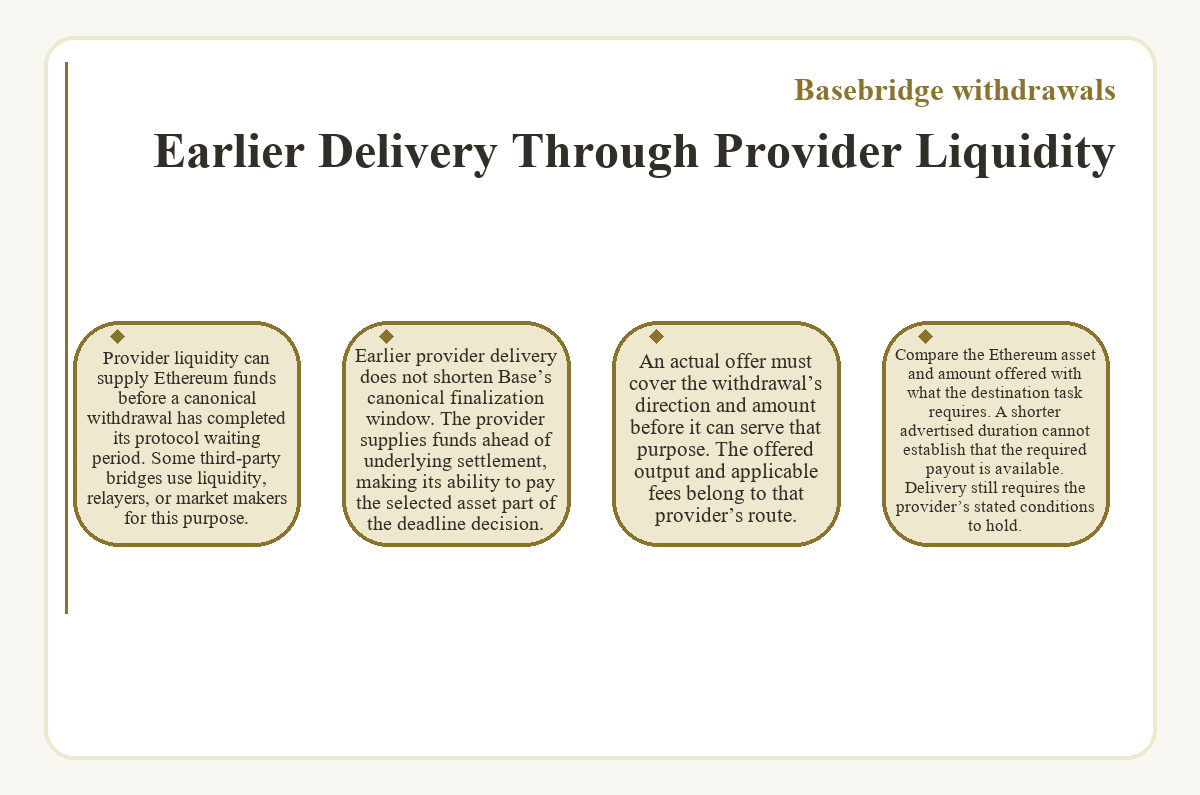
Provider liquidity can supply Ethereum funds before a canonical withdrawal has completed its protocol waiting period. Some third-party bridges use liquidity, relayers, or market makers for this purpose. Earlier provider delivery does not shorten Base’s canonical finalization window. The provider supplies funds ahead of underlying settlement, making its ability to pay the selected asset part of the deadline decision. An actual offer must cover the withdrawal’s direction and amount before it can serve that purpose.
The offered output and applicable fees belong to that provider’s route. Compare the Ethereum asset and amount offered with what the destination task requires. A shorter advertised duration cannot establish that the required payout is available. Delivery still requires the provider’s stated conditions to hold.
Withdrawal Readiness Before an Ethereum Deadline
A usable proposal must include the relevant Base state before proving can proceed. The ordinary path keeps the accepted proof useful while the supporting game remains valid. If the game becomes invalid, an earlier readiness result no longer establishes finalization eligibility.
Repeated state checks can reveal an invalidated supporting game while the withdrawal remains pending.
- Match the withdrawal’s recorded recipient and asset with the intended Ethereum use.
- Wait for a usable state proposal before submitting an unproven withdrawal’s inclusion proof.
- Check proof maturity and the supporting game’s valid claim before attempting canonical finalization.
- Re-prove against another admissible game if the original game is invalidated; the new proof resets that submitter’s timestamp.
- Treat earlier-delivery offers as separate route choices; a pending canonical withdrawal does not establish their availability.
Re-proving starts a new proof-age calculation for that submitter, which can move finalization eligibility beyond the original deadline.
Proven Messages and Received Ethereum Funds
A withdrawal proof establishes the message’s inclusion in committed Base state. The later finalizing transaction attempts the recorded action on Ethereum. An initiation hash or proving transaction can identify progress without establishing asset delivery. For a deadline tied to spending funds, the relevant outcome is the completed transfer at the destination.
An ETH transfer concerns the recorded recipient’s Ethereum ETH balance. A supported ERC-20 transfer concerns the correct destination token contract and recipient. Neither an initiating message’s ETH value field nor the existence of a proof establishes receipt of a bridged ERC-20. Canonical withdrawals can also carry messages for Ethereum contracts, where the intended outcome is the target action. Asset delivery and contract execution therefore require different readings of the destination state.
An Ethereum receipt’s transaction status alone cannot establish successful execution of a relayed contract call.
Ethereum Contract Calls and Portal Permissions
OptimismPortal permissions matter for exits whose recorded action calls an Ethereum contract. That contract sees the portal as its immediate caller during the L1 call. A withdrawal can carry arbitrary target calldata, so permissions granted to the portal affect the actions it can perform. ERC-20 tokens mistakenly sent directly to the portal can become claimable by anyone through withdrawal messages. A direct token send bypasses the intended standard bridge transfer mechanism. Sending tokens to the portal’s address therefore does not establish a completed bridge withdrawal or satisfy an Ethereum payment deadline.
Beryl Timing and Archived Bridge Instructions
Archived bridge examples describe earlier timing and test environments, making their constants unsuitable for a new mainnet deadline. The repository containing the native-bridge examples was archived on January 6, 2025. They describe a 7-day mainnet holding period and a 12-second testnet wait. Beryl changed the single-proof window while retaining the separate dual-proof fast path. Old commands and countdowns must therefore be interpreted within their original environment. A testnet holding period cannot establish mainnet delivery time, and an archived script does not establish availability of a replacement withdrawal route.
Quick answers about Basebridge withdrawals
Does the Original Base Sender Have to Prove and Finalize the Withdrawal?
A relayer can prove and finalize a canonical withdrawal without being its original Base sender. Both later actions take place on Ethereum. Delegating those actions does not remove the portal’s proof maturity or game-validity requirements, so another submitter cannot bypass the waiting conditions to meet a deadline.
Which Recorded Fields Can a Relayer Change to Accelerate Finalization?
A relayer cannot alter the withdrawal’s recorded fields during valid finalization. The proof binds the nonce, sender, target, ETH value, calldata, and gas limit to the original withdrawal. Changing those inputs would change the message being verified; replacing its recipient or gas limit is not a way to accelerate that exit.
Can Two Relayers Finalize the Same Withdrawal for Two Payments?
A canonical withdrawal can only be finalized once. OptimismPortal records its withdrawal hash to prevent repeat finalization. Multiple relayers may participate in the process, but submitting another finalizing transaction does not authorize another payout. This replay protection remains separate from whether the original target execution succeeded.
What Happens If the Ethereum Target Call Fails After Verification?
Successful verification does not guarantee the relayed Ethereum target call succeeds. OptimismPortal has no built-in replay for a failed raw target call. CrossDomainMessenger provides a separate replay mechanism and tracks failed messages. Recovery therefore depends on the messaging layer involved, and simply repeating portal finalization does not restart the failed withdrawal.
Is the Base-bound Deposit Sample a Shortcut for an Urgent Withdrawal?
The Base-bound deposit sample handles transfers into Base and must not be adapted into a withdrawal script. An urgent Ethereum exit needs an implementation supporting the withdrawal direction and its finalization requirements. Deposit execution and withdrawal completion use different mechanisms, so reversing the sample would not establish a valid shortcut.